
Transport Poverty: The Inequality You Cannot See from the Bus Stop
Source: Unsplash
Introduction
Most people do not think about how they would get to a hospital until they need to. And when that moment comes, they realize that having a car makes all the difference. For the elderly, the young, and lower-income residents, the answer to that question depends entirely on where they happen to live.
This is what researchers call transport poverty: not simply the absence of a bus stop, but the inability to reach essential services within a reasonable time using public transport. It is a problem that is rarely discussed, partly because it is hard to see. You cannot easily spot it on a map or read it in a headline.
But it can be measured. And when you do measure it, the results are striking.
The 30-Minute Threshold
The standard benchmark in transport accessibility research is 30 minutes. If you can reach a hospital within half an hour by public transit, you are considered adequately served. Beyond that, studies consistently show that people with chronic illness, mobility limitations, or no alternative means of transport are significantly more likely to delay or avoid care altogether.
Delayed care has real consequences: conditions go undiagnosed, emergencies escalate, and the health gap between well-connected and poorly-connected neighbourhoods widens over time. Transport poverty, in this sense, is also a public health issue.
How Travel Times Were Calculated
To map hospital accessibility across Milan, I used real public transport data from Milan's transit authority combined with the city's road network and a routing tool called r5py, which simulates actual door-to-door journeys by transit and on foot.
For each of hundreds of origin points across 32 districts, the analysis calculated the minimum travel time to the nearest of 30 hospitals. All journeys were simulated departing on a weekday morning at 8:00 AM. Any origin point where the fastest possible journey exceeded 30 minutes was classified as transport-poor.
The districts covered a wide range of Milan's urban fabric, from the dense, central neighbourhood of Duomo to peripheral areas like Figino, Gratosoglio, and Lambrate.
Source: ATM
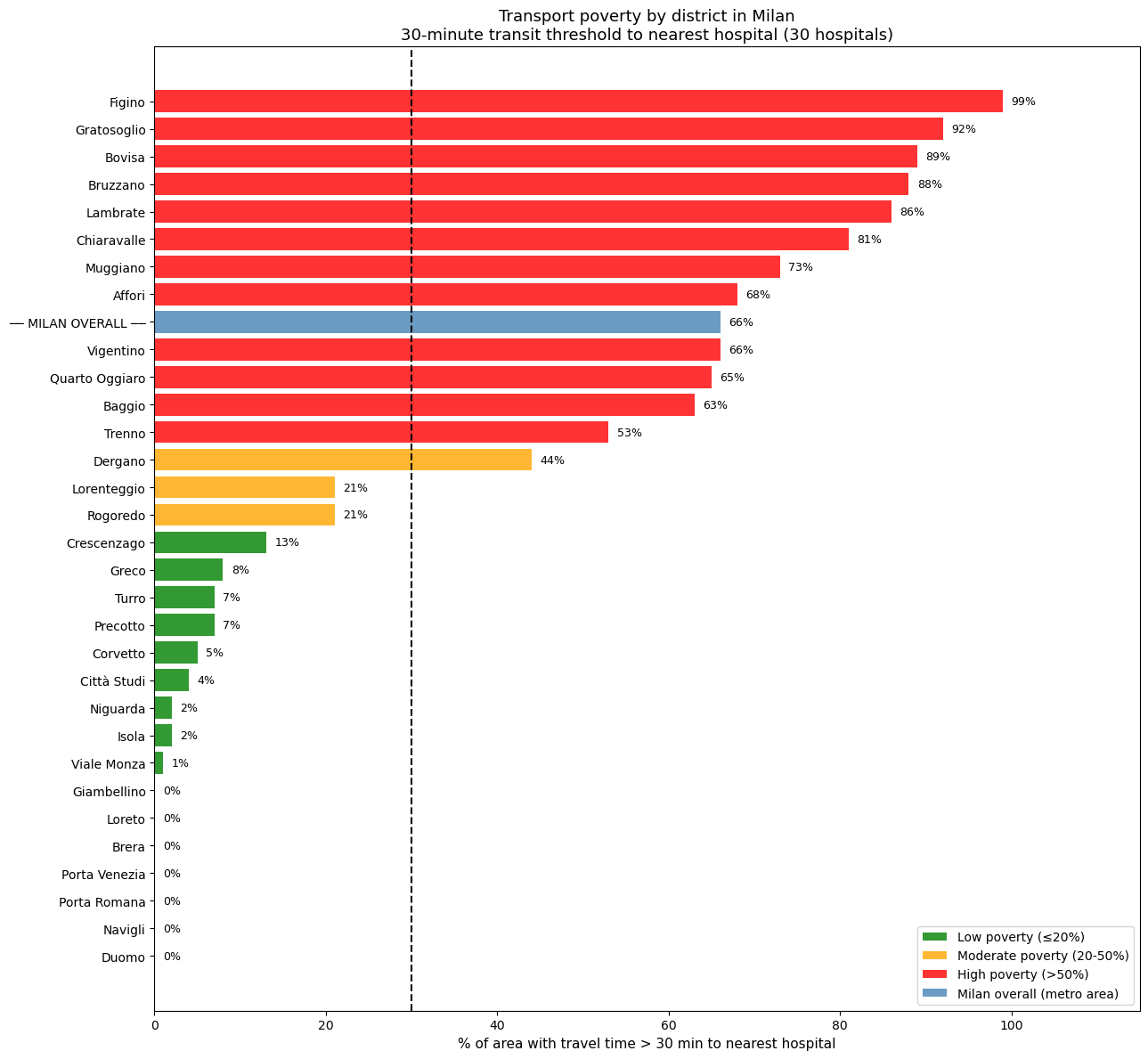
The differences between districts are stark. Central neighbourhoods like Duomo, Navigli, Brera, Porta Romana, Porta Venezia, Giambellino, and Loreto record 0% transport poverty. Città Studi sits at just 4% and Corvetto at 5%. Then things shift sharply at the periphery: Dergano reaches 44%, Trenno 53%, Baggio 63%, Quarto Oggiaro 65%, Affori 68%, Muggiano 73%, Chiaravalle 81%, Lambrate 86%, Bruzzano 88%, Bovisa 89%, Gratosoglio 92%, and Figino at 99% — essentially the entire district beyond the threshold.
These are not marginal differences. A resident of Figino faces a transit reality that is categorically different from a resident of Brera, even though both live within the city limits of Milan.
Who Bears the Cost
The geography of transit disadvantage does not fall randomly. Peripheral districts in Milan tend to have higher concentrations of elderly residents, younger populations with less economic independence, and lower-income households.
This overlap is not a coincidence since it reflects a wider pattern seen in cities across Europe: transit investment tends to follow economic activity, reinforcing existing inequalities rather than correcting them. Those who need the service most are often the ones served least.
The consequences are not abstract. When getting to a hospital takes 50 minutes by bus, routine check-ups get skipped. When a medical appointment requires two transfers and a long wait at an exposed stop, elderly residents may simply not go.
Having a Stop Is Not the Same as Having Access
One reason transport poverty goes unnoticed is that most people assume the presence of a bus stop means adequate coverage. But a stop is not the same as access. What matters is the waiting time, frequency, transfers, and walking distance at both ends.
In Milan's peripheral districts, stops may exist, but service is infrequent, connections are indirect, and walking routes to the stop are often poorly maintained. The result is that the theoretical network looks denser than the lived experience actually is.
This is also why journey time is a better measure of accessibility than stop proximity. It captures the reality of the trip, not just the presence of infrastructure.
What This Means for Policy
Measuring transport poverty does not automatically fix it. But it is a necessary first step. Without precise, district-level data on who is underserved and by how much, policy decisions about route coverage, service frequency, and infrastructure investment are made in the dark.
The good news is that this kind of analysis no longer requires large budgets or specialised institutions. Open data from transit authorities and freely available routing tools make it possible for any city government or urban planner to produce this picture in hours.
The harder question is political. Knowing that 66% of Milan overall —and 99% of Figino —cannot reach a hospital in 30 minutes by bus and choosing not to act on that information is a different kind of problem that data alone cannot solve.
Conclusion
Transport poverty is one of those issues that hides in plain sight. However, for large parts of Milan, reaching a hospital by public transport in under 30 minutes is simply not possible.
The 30-minute threshold is not just an abstract benchmark, because it is the difference between a city that works for everyone and one that works only for those who happen to live in the right place or own a car.
Transport is often treated as an infrastructure question. But as the numbers from Milan show, it is also a question of health, equality, and who the city is actually built for.